

Electrical energy powers almost everything we do, from lighting our homes to charging the devices in our pockets, yet many of its most fascinating details stay hidden in plain sight.
Behind every switch and socket are ideas about how energy moves, why power systems are built the way they are, and what actually happens inside wires and electronics. Here are six interesting electrical energy facts that will change how you think about electricity in daily life.
Electrical Energy Is “Ordered Motion”
Electrical energy isn’t a substance stored inside a wire. It’s a way of describing how electric charges move and how that motion can do work, like turning a motor, lighting an LED, or running a phone charger. It’s the same motion a general electrician accounts for when tracing power problems through a home’s wiring.
In many everyday circuits, the charges are electrons drifting through a conductor, but the drift speed is actually quite slow. What feels fast is the transfer of energy through the electric field that forms around the circuit.
This is why flipping a switch can light a bulb almost instantly, even though individual electrons inch along. The signal and energy move through the field at a large fraction of the speed of light, shaped by the materials around the conductor.
Voltage and Current Do Different Jobs
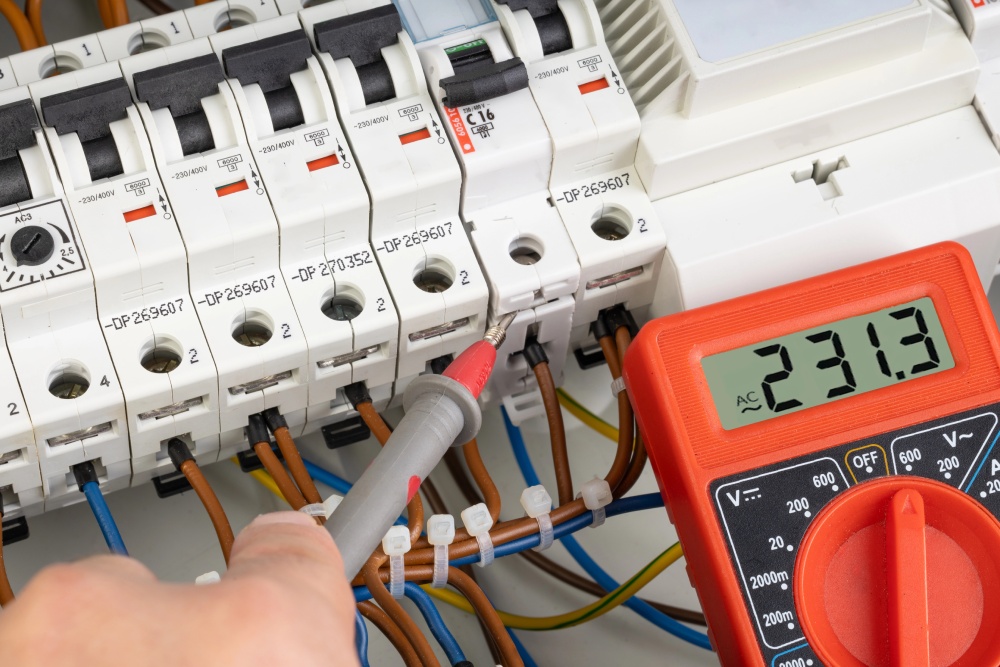
People often mix up voltage and current, but they describe different things. Voltage is the “push” that encourages charges to move, while current is the rate at which charge flows. Power ties them together through. A device can use the same power with high voltage and low current, or low voltage and high current.
That difference matters in real systems. Power lines use high voltage so they can deliver lots of power with lower current, which reduces heating losses in the cables.
Most Grid Electricity Is AC for a Practical Reason
You may hear about the historic rivalry between alternating current (AC) and direct current (DC). Today’s grids mostly use AC because it can be transformed between voltage levels efficiently using transformers. Stepping voltage up for long-distance transmission cuts losses, then stepping it down makes it safer and more usable for homes and businesses.
DC still plays a major role. Solar panels produce DC, batteries store DC, and many electronics run internally on DC, which is why adapters and power supplies are everywhere.
Electricity Rarely Comes “from” the Power Plant the Way You Think
When you use electricity at home, you are not receiving a stream of brand-new electrons shipped from a distant generator. In most cases, the electrons moving in your house wiring were already there. The power plant helps set up an electric field across the grid, and that field drives charge motion throughout the network.
A helpful image is a long line of marbles in a tube. Push one marble at one end, and another marble pops out quickly at the other end, even though each marble moved only a little. The grid behaves in a similar, field-driven way.
Energy Losses Show Up as Heat, Sound, and Light
No real system converts electrical energy into useful output with perfect efficiency. Some energy becomes heat due to resistance in wires and components. Motors also lose energy as heat and sound because of friction, vibration, and magnetic effects. Even phone chargers get warm because conversion from AC to DC and voltage regulation is not perfect.
This is one reason “phantom loads” matter. Devices left plugged in can still draw small amounts of power for standby features, displays, or network connectivity, adding up across months.
Storage Is the Hard Part, Not Generation
Generating electricity can be done in many ways: turbines driven by steam, wind, or water; photovoltaic cells converting sunlight; and more. The tougher challenge is storing large amounts of energy cheaply and then delivering it when demand spikes. Batteries, pumped hydro, compressed air, and thermal storage all help, but each option comes with trade-offs in cost, location limits, and performance.
That is also why the grid relies on balancing supply and demand in real time. Small changes, like many AC units switching on at once, can affect frequency and stability, so operators constantly adjust generation and load.
Trusted Electricians for Homes and Businesses in Houston and DFW
If reading these facts made you look at your home’s power a little differently, it’s also a good reminder that electricity is something to respect and to have checked when things don’t feel quite right. At Aaron’s Electrical Service, we provide residential and commercial electrical services in Houston and the Dallas–Fort Worth area, from troubleshooting flickering lights and breakers that keep tripping to larger upgrades like rewiring and standby generator work.
Need help now or want peace of mind before a small issue becomes a bigger one? Request an appointment, and your service is backed by a lifetime workmanship warranty and a 100% satisfaction guarantee.