

Quick Summary
A commercial site performs when people can see where they are going and recognize a face, which depends on distribution rather than raw output. Around one footcandle of average horizontal illuminance suits a general lot, with enhanced security areas closer to two and a half, and the ratio between the average and the darkest point held near five to one. Pole height sets reach, spacing follows from that height, and the optic assigned to each position removes dark gaps without adding fixtures. Vertical illuminance is what cameras depend on, while backlight, uplight, and glare ratings control what escapes past the property line.
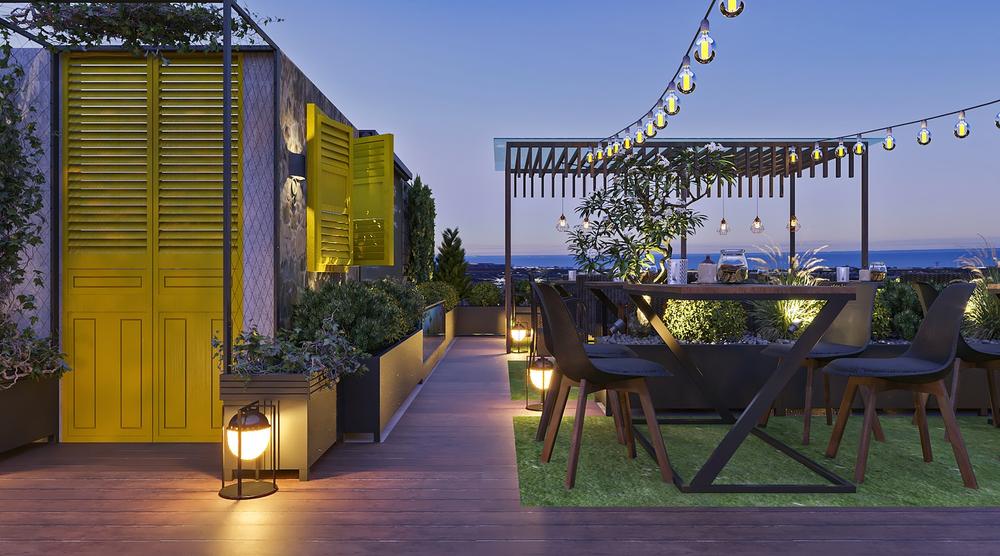
A business property is judged after dark whether anyone intends it or not. Customers decide how safe a parking lot feels within a few seconds of pulling in, staff notice which corners they avoid on the walk to their car, and insurers take an interest in both. Commercial landscape lighting carries a heavier burden than the residential version, since the same installation has to satisfy safety, security, code, and the way the property looks from the road. Here is what separates a system that performs from one that consumes power.
What Effective Means On a Commercial Site
Brightness alone answers none of the questions a property owner actually has about a site. A site performs when people can see where they are going, recognize a face at conversational distance, and read a sign or a door number without any effort. Those outcomes depend on how light is distributed rather than how much of it leaves the fixtures in the first place. A lot flooded from four corners can still hide a person standing between two vehicles, while a modest system laid out properly leaves nowhere for that to happen. Liability follows the same logic, since claims after an incident tend to focus on dark areas rather than on total wattage. Defining what the property needs to accomplish comes before any fixture gets specified or any pole gets ordered.
Light Levels and Uniformity Across the Property
Without a figure to aim at, a lighting design is nothing more than guesswork. A commercial lot works well around one footcandle of average horizontal illuminance, while areas carrying an enhanced security expectation move closer to two and a half footcandles. Averages alone hide the problem, which is why the ratio between the average and the darkest measured point deserves as much attention as the target itself. Keeping that ratio near five to one produces a surface the eye can scan without constant adjustment. Wide swings between bright pools and deep shadow tire drivers and pedestrians, and they create exactly the pockets a security consultant would flag first. A photometric layout run before purchase predicts all of this on paper rather than after the poles are set in concrete.
Pole Height, Spacing, and Distribution Patterns
Geometry does most of the work in an area lighting design. Mounting height sets how far a fixture can reach, and twenty feet is a starting point on a surface lot. Spacing follows from that height, with poles in the 15 to 20-foot range usually landing twenty to thirty feet apart, and taller poles stretching to forty. Optics finish the job, since a fixture aimed down a row of spaces needs a different distribution than one sitting on a perimeter edge or in the middle of open ground. Manufacturers publish those patterns, and matching the right one to each pole position is what removes dark gaps without adding fixtures. Fewer poles carrying the correct optic will always beat more poles carrying the wrong one.
Vertical Surfaces and Why Cameras Depend On Them
Light landing on the pavement tells a camera almost nothing about a face. A lens needs illumination falling on the front of a person, which is measured on an upright plane rather than a flat one, and a quarter of a footcandle is a reasonable floor in areas where identification is the whole point. Entrances, ATM surrounds, loading doors, stairwells, and pedestrian routes all belong squarely in that category. The same principle improves how a property reads from the street, since a lit façade, a monument sign, or a planted island gives the eye something to land on as it approaches. Sites lit only downward feel darker than they measure, and lifting a few upright surfaces changes that impression entirely for very little money.
Glare, Light Trespass, and BUG Ratings
Two properties can measure the same on paper and feel different to stand in. What separates them is how much output escapes where nobody wants it, which shows up as brightness in a driver’s eyes, spill across a neighboring lot, and a wash into the sky. Outdoor fixtures carry a rating that describes this, scoring backlight, uplight, and glare on a scale where lower numbers mean tighter control. A zero in the uplight category means nothing leaves the fixture above horizontal, which is the requirement in dark sky ordinances. Municipalities write those limits into zoning, so checking the local requirement before specifying saves an expensive correction later. Shielding costs nothing when it is chosen at the start and a great deal when it is retrofitted.
Controls, Schedules, and Ongoing Maintenance
Every hour a fixture runs unnecessarily costs money and quietly shortens its service life. Photocells handle dusk-to-dawn switching, while astronomical time clocks follow the calendar and let a site step down to a lower level after closing time. Occupancy sensing suits back lots and service areas where nobody is present through most of the night. Energy codes in a growing number of jurisdictions require some form of automatic reduction, so the controls are rarely optional. Output also fades gradually across a fixture’s life, which means a lot that met its targets on day one may not meet them in year eight. Scheduling a periodic light level check across the site catches that drift before a customer complaint does.
Building the Plan Before the Poles Go Up
A commercial site rarely fails for lack of fixtures. It fails where the layout was never calculated, where the optics were chosen from a catalog rather than a plan, and where nobody looked at the property again after the first year. Getting those three things right produces a site that feels safe, satisfies the people who inspect it, and costs less to run than the one it replaced.
Aaron’s Electrical Service designs, installs, and maintains commercial outdoor lighting across the Houston and Dallas-Fort Worth areas, covering parking lot poles, wall packs, walkway fixtures, façade and entrance lighting, and the controls that run them. Our licensed electricians also handle commercial generators, transfer switches, surge protection, and scheduled electrical maintenance for property managers. All of our work is permitted and backed by a lifetime workmanship warranty.
Dark spots on your property? Call us at 281-719-0464 in Houston or 469-998-0097 in Dallas-Fort Worth for an after-hours site walk.
FAQs
How bright does a commercial parking lot need to be?
A general lot performs well around one footcandle of average horizontal illuminance, with enhanced security areas closer to two and a half. The average alone is misleading though, since a lot can hit its target while leaving deep pockets of shadow. Uniformity across the surface deserves equal weight in any design.
What is a BUG rating?
A scale describing where a fixture sends light it was never meant to send. Backlight covers spill behind the unit, uplight covers everything above horizontal, and glare covers high angle brightness. Lower numbers mean tighter control, and a zero uplight rating is what dark sky ordinances generally require of a fixture.
Why do my cameras still miss faces in a lit lot?
Ground level light does little for a lens. A camera needs illumination on the upright plane facing the subject, and a quarter of a footcandle is a reasonable floor where identification is the point. Adding vertical light at entrances, doors, and pedestrian routes usually solves it without raising overall levels.