

Quick Summary
Light placed above a subject, behind it, or right against it produces entirely different results from the same fixture. Mounting high in a canopy and aiming down mimics moonlight across a patio, while a source set behind a plant and aimed at a wall turns that plant into a pure outline. Close-range beams grow leaf shadows across a fence and reveal texture in brick and stone that flat light hides completely. Still water doubles anything lit near it, and separating fixtures onto different circuits lets one yard serve a quiet evening and a party without rewiring.
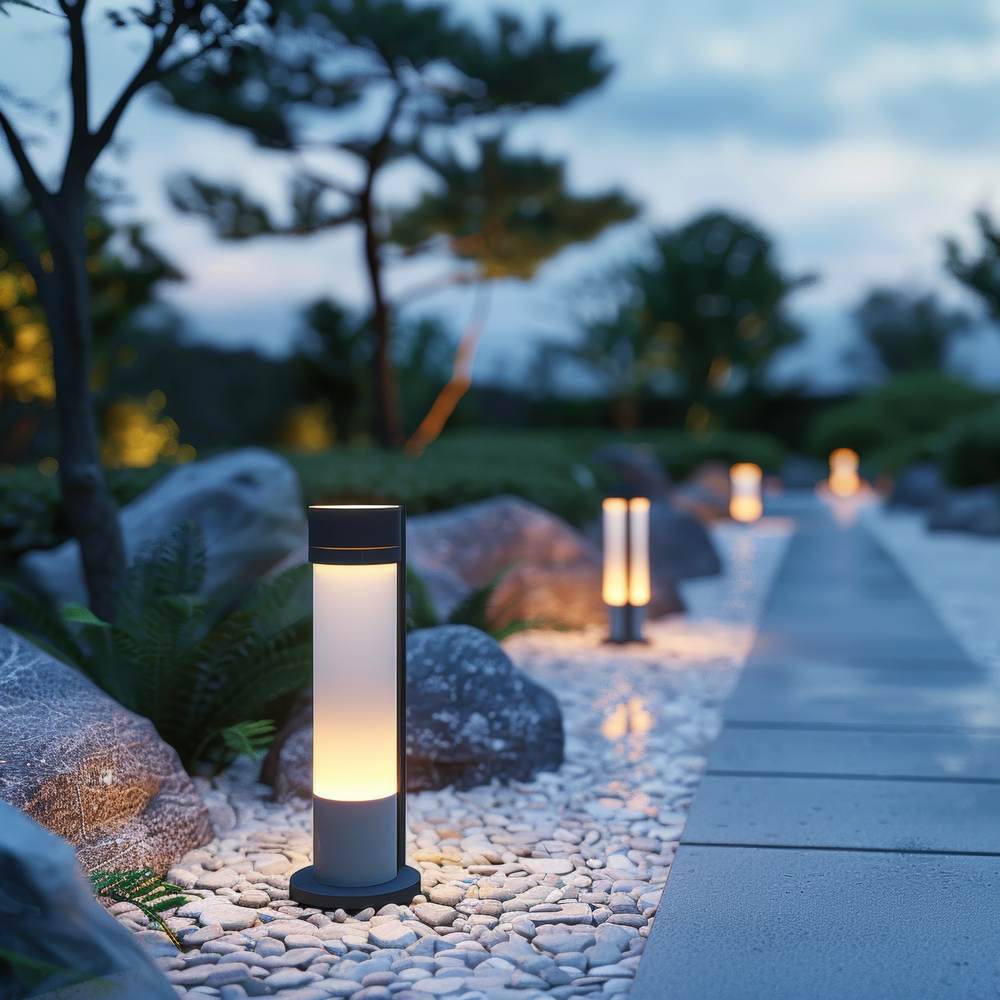
Daylight flattens a garden completely. Every plant, wall, and path receives the same light from the same direction, and the eye stops noticing any of it by afternoon. Darkness hands that control back to you, since the only things visible after sunset are the ones you choose to light. That shift is what separates a few fixtures in the ground from landscape lighting ideas that give a property a second personality after dark. Let’s look at what a single beam can do once you decide exactly where to point it.
Moonlighting From High In a Tree Canopy
Nothing on the ground reproduces the quality of light that falls from above. Mounting a fixture thirty feet up in a mature oak and aiming it down through the branches creates exactly that, since the leaves break the beam into a pattern of light and shadow across whatever sits below. The effect works best over a patio, a lawn, or a driveway, and it lights those spaces without a glaring source at eye level. Warm output keeps the illusion intact, while anything cool and blue reads as a security light rather than moonlight. Mounting hardware needs to allow for the tree growing around it, so the fixture never strangles a limb over time. Done well, guests notice the space rather than the fixture lighting it, which is exactly the point.
Silhouetting a Shape Against a Lit Surface
Reverse the usual arrangement of light and subject and something interesting happens. Place the light behind an object and aim it at the wall or fence beyond, and the object itself goes dark while its outline becomes the subject. A Japanese maple, an agave, a piece of sculpture, or an ornamental grass all carry shapes distinct enough to read as pure form against a flat surface. Success depends on the backdrop, since a plain stucco wall or a smooth fence panel gives the outline somewhere clean to sit. Busy backgrounds destroy the effect, so the technique suits a courtyard or a side yard far better than an open lawn. Keep the source hidden behind the plant itself, since a visible fixture pulls attention straight to the wrong place in the scene.
Shadow Play With a Low-Angled Beam
An enlarged version of a plant lands on the wall behind it when the fixture sits close to the base with the beam angled upward. Ferns, palms, and anything with an open structure produce striking results, while dense shrubs turn into a shapeless blur. Distance controls scale, so moving the fixture a few inches toward the plant grows the shadow considerably larger. Wind becomes part of the design, since a breeze sets the whole pattern moving across the wall. The technique rewards restraint, and one or two sources beat a row of them competing for the same surface. Painted walls, garage doors, and privacy fences all serve as canvases, and the best one is usually whichever surface you look at most from indoors at night.
Grazing a Textured Wall From Close Range
Stone, brick, and stucco lose all their character under flat light and come fully alive under a steep one instead. Setting a fixture six to twelve inches from the surface and aiming the beam straight up the face throws every joint, ridge, and irregularity into sharp relief. The closer the source sits, the sharper the shadows become, which is why the distance deserves testing on site rather than guessing from a plan. Smooth surfaces gain nothing from close-range light, so save the technique for material that has something real to show. Chimneys, retaining walls, stone columns, and fireplace surrounds all respond particularly well to it. A linear fixture spreads the effect evenly across the wall where a spotlight would leave a single bright cone.
Reflections Across Water and Glass
Any still surface doubles whatever you put in front of it. A pool, a pond, or a stock tank turns a single lit tree into two, and the version on the water moves whenever the surface does. Submersible fixtures inside a water feature light it from within, which suits a fountain or a spillway better than a spotlight aimed at falling water from the bank. Large windows perform the same trick from indoors, since a lit garden replaces the black mirror your glass becomes after sunset. Aim carefully around seating areas, though, since the same reflection that flatters a pond can put a beam directly into someone’s eyes across the yard. Testing the view from a dining chair costs nothing and saves an awkward evening.
Layered Zones for Entertaining After Dark
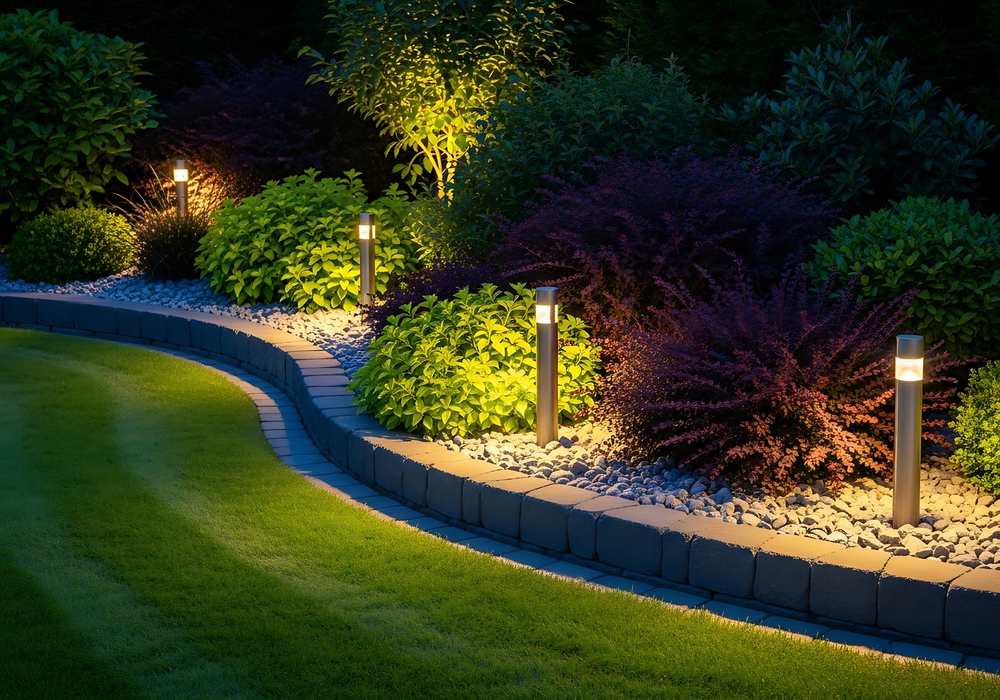
Good outdoor rooms work the same way interiors do, with light arriving at several heights instead of one. Ground-level fixtures mark the edges of a patio, mid-height sources pick out planting and structure, and something overhead ties the whole space together. Separating those layers onto different circuits lets you run a quiet weeknight setting or bring everything up for a party. Dimming adds another dimension, since the same yard reads differently at full output and at thirty percent. Cooking and serving areas need more light than conversation areas, a distinction worth deciding before anything gets installed. A layout built around how you use the space holds up longer than one built around a fixture you happened to like.
Bringing These Ideas to Your Own Property
None of this depends on an expensive fixture. What separates a yard that stops people at the gate from one that merely has lights in it is the decision about where the beam lands and what it leaves dark. Restraint does more work than wattage, and a plan built around a few strong moments outperforms a perimeter of identical fixtures every time.
Aaron’s Electrical Service designs and installs landscape lighting across the Houston and Dallas-Fort Worth areas, handling the fixtures, the transformer, the buried runs, and the separate circuits that make layered scenes possible. Our licensed electricians also install outdoor receptacles for entertaining areas, security and parking lot lighting for commercial properties, and whole-home surge protection to guard the system once it is in. All of our work carries a lifetime workmanship warranty.
Have a tree or a wall in mind? Call us at 281-719-0464 in Houston or 469-998-0097 in Dallas-Fort Worth to talk it through.
FAQs
How many techniques should one yard use?
Two or three usually carry a property. Mixing every effect at once produces visual noise, since each technique competes for attention rather than building on the last. Pick the strongest feature in each view, treat it deliberately, and leave the rest dark. Contrast is what makes any of it register at all.
Will moonlighting hurt the tree?
Not when the mounting hardware allows for growth. A fixture strapped tight to a limb becomes a problem as the tree expands around it, so adjustable mounts and periodic checks are part of the installation. Cable routing needs the same consideration. Done properly, the tree carries the fixture for years without damage.
What color temperature suits these effects?
Warm output between 2700K and 3000K flatters foliage, brick, stone, and skin, and it keeps moonlighting believable. Anything at 4000K or above reads cool and industrial, which undoes the effect regardless of how well the fixture is aimed. Consistency across the whole yard counts for more than the exact number chosen.