

Quick Summary
The right breaker for your AC is a double-pole, thermal-magnetic breaker sized exactly to the data plate on your outdoor unit. Most modern breakers are HACR-rated, which means they handle the startup surge without nuisance tripping. Knowing what type of circuit breaker for air conditioner applications is safe starts with checking the nameplate and understanding the difference between single-pole (120V) and double-pole (240V) breakers.
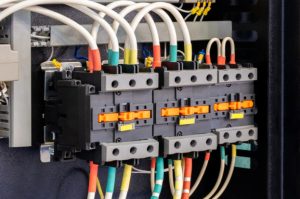
We have seen many DFW homeowners deal with ACs that trip the breaker repeatedly or run on a breaker that is too large and creates a fire risk. Choosing the correct breaker is not complicated, but it is very important for safety and equipment life.
Most central ACs need a double pole, HACR rated breaker between 15 and 60 amps. For complete safety, we recommend professional electrical panel installation. This guide explains how to find the correct type and size.
Understanding Common Types of AC Breakers
When shopping for a new breaker or checking the one in your panel, you will see several different styles. Knowing the basic types helps you ask the right questions.
Single-Pole Breakers. These narrow switches take up one slot in your electrical panel. They provide 120 volts and are used for standard lights and plugs, but they can also power small window or portable air conditioners that use 120V. We always remind our customers that a single-pole breaker is never the correct choice for a central air conditioner, which needs 240 volts.
Double-Pole Breakers. A double-pole breaker looks like two switches joined together. It connects to both bus bars in the panel to deliver 240 volts, which every central AC compressor requires. These breakers come in amperages from 15 up to 60 or more, and you will usually find one labeled “AC” or “HVAC” in your main panel.
Standard Thermal-Magnetic Breakers. This is the most common type of breaker in residential panels. It uses a bimetal strip that bends with heat to detect a sustained overload, plus a magnetic coil that trips instantly during a short circuit. This design is ideal for air conditioners because it allows a brief motor startup surge without tripping while still protecting against real faults.
HACR Breakers. HACR stands for Heating, Air Conditioning, and Refrigeration. In the past, HACR was a special rating that you had to look for on the breaker label. Today, nearly every modern UL 489 listed circuit breaker is automatically HACR-rated. That means if you buy a new double pole breaker from a major brand like Square D, Siemens, or Eaton, it already meets the HACR requirement. However, we still recommend verifying the label to be safe, especially when installing a new AC or replacing an older panel.
How to Determine Exactly Which Breaker Your AC Needs
The only reliable way to answer “what type of circuit breaker for air conditioner is correct” is to read the nameplate on your outdoor condenser unit. We always start every inspection at this data plate. It lists two critical numbers:
Minimum Circuit Ampacity (MCA). The smallest wire size you can safely use.
Maximum Overcurrent Protection (MOCP). The largest breaker allowed. Never exceed this number.
The National Electrical Code (NEC) Article 440 requires you to follow these ratings. For example, a 3 ton central AC might have a MOCP of 40 amps and an MCA of 24 amps. You would install a 40 amp double pole breaker with 10 gauge wire. We use these rules every time we install a new AC circuit.
Sizing a Breaker by AC Unit Size
If you do not have the nameplate, estimate based on cooling capacity, but always confirm before buying.
1.5 ton (18,000 BTU). 20 amp double pole breaker, 12 gauge wire.
2 to 2.5 ton (24,000 30,000 BTU). 25 or 30 amp breaker, 10 gauge wire.
3 to 5 ton (36,000 60,000 BTU). 30 to 40 amp double pole breaker, 8 gauge wire.
Small mini split (12,000 24,000 BTU). 15 to 20 amp breaker, 12 or 14 gauge wire.
About Aaron’s Electrical Service
At Aaron’s Electrical Service, we are a Christian family owned company serving DFW homeowners with licensed electricians and a lifetime workmanship warranty. We have helped hundreds of families install the correct breakers for new ACs and replace dangerously oversized ones.
We offer free inspections and clear pricing. We are available Monday through Saturday, 24/7 for emergencies. When you need commercial electrical repairs and replacements, we are here to assist.
Comparing Standard, HACR, and High Magnetic Breakers
You might encounter a few breaker types beyond the basic thermal magnetic design. We explain the differences to every homeowner.
Standard Inverse Time Breakers. This is the default choice for residential ACs. It balances motor startup current with short circuit protection. We install these for 90% of the units we service.
HACR Breakers. HACR breakers are standard UL 489 breakers tested for motor loads. If you see “HACR” printed on a new breaker, it is confirmation of passing those tests. However, the absence of the word does not mean the breaker is unsuitable. A UL 489 label is sufficient for modern HVAC systems.
High Magnetic (Type C) Breakers. For very large compressors, a Type C breaker holds during high inrush current. For most residential ACs, a standard thermal magnetic breaker already works. For large heat pumps, we often specify a Type C to avoid nuisance trips.
The Important Exception: Outdoor Disconnect Boxes
Most residential AC circuits include a second safety device: a pull out disconnect or small breaker in a weatherproof box next to the outdoor unit. This disconnect must have the same amperage rating as the main breaker. We always verify it is properly sized and free of corrosion. For professional HVAC circuit services, our team is ready to help.
FAQs
Can I use a 30 amp breaker if the nameplate calls for a 25 amp HACR breaker?
No. A larger breaker can allow wires to overheat before tripping, creating a fire hazard. Always follow the nameplate exactly.
Is a GFCI or AFCI breaker required for an outdoor AC unit?
The NEC varies by installation year and location. Most outdoor units still use standard breakers. Some local codes require ground fault protection. A licensed electrician can review your setup.
How can I tell if my existing breaker is HACR rated?
Look for “HACR” or “UL 489” on the side. Most breakers made after 2000 are HACR compliant. If unsure, we can test and replace it.
Why does my new AC require a different breaker than my old one?
Newer ACs may have inverter technology or different starting characteristics. Always use the new nameplate rating. Never assume the old breaker is correct.