

Quick Summary
Your HVAC circuit breaker location depends on your home’s layout and system type. Most breakers live in the main electrical panel found in garages, basements, or utility rooms. A second safety device, called a disconnect box, is often mounted on the wall right next to the outdoor AC unit. Knowing both spots can save you time and prevent safety risks when you need to cut power quickly for maintenance or emergencies.
When your air conditioner stops working on a hot day or you smell something strange near your furnace, the first safety step is turning off the power. But finding the right switch can feel like a puzzle if no one has shown you where to look. We have helped many homeowners in DFW trace electrical problems back to a simple tripped breaker.
Understanding your HVAC circuit breaker location is not just convenient; it is a key part of keeping your family safe. For larger electrical upgrades, we offer trusted electrical panel installation.
The Main Electrical Panel: Your First Stop
The main electrical panel is a gray metal box mounted to a wall inside your home. This is the primary home for your HVAC breaker. We always check this panel first during inspections because it controls almost every circuit in your house.
The most common places to find this panel include:
Garages. This is the most frequent spot for modern homes. Builders place the panel near the wall where the power line enters from outside.
Basements. If your home has a basement, check the walls near the furnace or the main power meter.
Utility rooms or closets. Some homes put the panel in a dedicated room with the water heater or inside a hallway closet.
Near the front entrance. In some designs, the panel is hidden behind a small door in an entryway.
Once you open the panel, look for a large double switch that is about one inch wide. This is your HVAC breaker. It may be labeled “AC,” “Air Conditioner,” “Furnace,” “Heat Pump,” or “HVAC.” If the labels are handwritten, they may be faded or hard to read. We recommend taking a photo of your panel with your phone so you have a record of which switch does what.
How to Identify the Correct Breaker
If your panel has poor labeling or no labels at all, you can find the right breaker using a few simple tricks. Our team teaches homeowners to identify the right breaker by looking for double-pole breakers. An HVAC breaker is almost always a double switch, meaning two switches connected by a single bar or pin. This is because air conditioners and heat pumps run on 240 volts, not the standard 120 volts used by lights and plugs.
You can also check the amperage rating. AC breakers are usually marked 30, 40, 50, or 60 amps. A standard wall outlet uses only 15 or 20 amps. If you see a large number on a double switch, it is very likely your HVAC breaker. We always remind homeowners that amperage numbers are printed on the handle or side of the switch.
Another method is the “thermostat test.” Turn off one double breaker at a time, then go check your thermostat. If the screen goes blank or the system does not respond, you have found the correct one. We use this method ourselves when labels are missing or unclear.
The Outdoor Disconnect Box
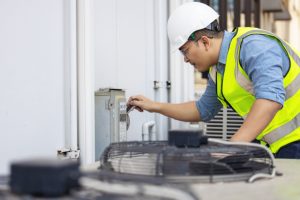
Do not forget the second safety device located outside. Near your outdoor condenser unit (the large metal box with a fan), you will often find a small gray box mounted on the wall. This is called a disconnect box or service switch. We remind our customers to stay safe around their panels and show every family member where this box is.
What is the purpose of this box?
This box lets you shut off power to the outdoor unit without going all the way back to the main panel. This is very useful for technicians performing maintenance or cleaning the coils. It is also required by electrical code.
What does it look like?
Some disconnect boxes have a large plastic handle that you pull out to kill the power. Others have a simple light switch inside that flips off. In some cases, you might see a small metal handle that rotates. We always advise homeowners to check this box first if the outdoor unit stops running. Someone may have accidentally bumped the handle, turning off the power.
About Aaron’s Electrical Service
At Aaron’s Electrical Service, we are a Christian family-owned company serving DFW homeowners with licensed electricians and a lifetime workmanship warranty. We have helped hundreds of families locate hidden breakers and fix dangerous electrical issues. We know that finding the right switch can be frustrating when panels are old and labels are missing.
Our team offers free inspections and clear, honest pricing. We are available Monday through Saturday, 24 hours a day for emergencies. When you need commercial electrical repairs and replacements, we are here to assist.
Safety Tips for Accessing Your Breaker
While knowing your HVAC circuit breaker location is important, there are a few rules to follow to stay safe. At Aaron’s Electrical Service, we train homeowners to stay safe around their panels.
Do not touch the panel with wet hands. Water conducts electricity, and even a small mistake can cause a serious shock.
Stand to the side when resetting a breaker. If the breaker fails internally, it could spark. Standing to one side keeps your face and body out of the direct line.
Listen for buzzing or popping. If your panel makes unusual sounds, do not touch it. Call a licensed electrician immediately.
Keep the panel clear. Do not stack boxes or hang clothes in front of the electrical panel. You need quick access in an emergency.
When the Breaker Won’t Stay On
If you find your HVAC circuit breaker location and reset it, but it trips again instantly, do not keep resetting it. This is a sign of a deeper problem. Common causes include a dirty condenser coil, a failing compressor, loose wire connections, or a bad motor.
We have also seen melted wires inside disconnect boxes, which creates a fire risk that is not visible until the cover is removed. This is why we always recommend a licensed electrician for diagnostic work. For professional HVAC circuit services, our team is ready to help.
FAQs
Can an HVAC system have more than one breaker?
Yes. Many systems have separate breakers for the indoor air handler and the outdoor condenser. The indoor unit might be on a single 15 or 20 amp breaker, while the outdoor unit requires a double 30 to 60 amp breaker.
What should I do if my breaker panel is not labeled?
You can use a circuit breaker finder tool from a hardware store. This device plugs into an outlet near the HVAC system and sends a signal to a wand that beeps when you hold it over the correct breaker. Or, call a professional electrician to map and label your panel for you.
Is it dangerous to open the main electrical panel myself?
Yes. Even with the main breaker turned off, the large wires coming into the panel from the power company remain live. Only a licensed electrician should remove the panel cover for inspection or repair.
Why is the outdoor disconnect box required by code?
Electric codes require a service disconnect within sight of the outdoor unit. This ensures that a technician can see the box and confirm the power is off while working on the condenser. It adds a layer of protection against accidental shocks.